

Third-Party Certification for Fire Pumps: UL, FM, APSAD, and SETSCO Explained
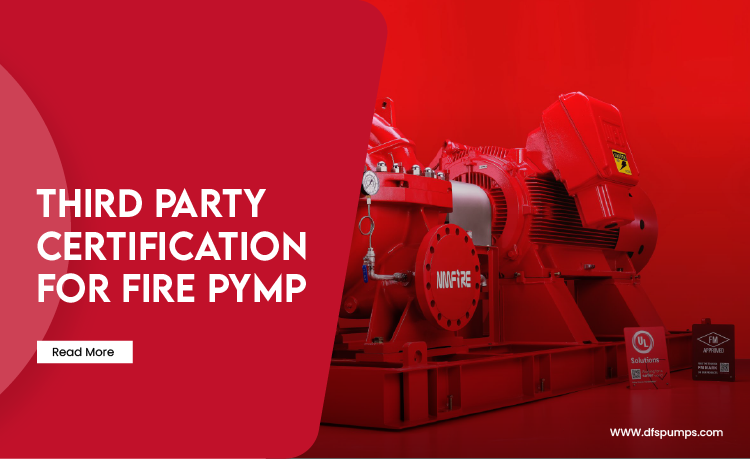
Introduction
Walk into any serious tender document for a commercial or industrial project today, and you will almost certainly find a certification requirement listed alongside the fire pump specification. UL listed. FM approved. Sometimes both. On international projects with European or Asian design standards in play, APSAD certification or SETSCO listing may appear as additional requirements. For anyone buying, specifying, or supplying fire pumps, understanding what each of these certifications actually means what they test, who issues them, and why they differ is not optional knowledge anymore.
The problem is that most of the available content on this topic either oversimplifies (“UL and FM are basically the same”) or dives so deep into regulatory detail that it becomes unreadable. Neither serves the engineer trying to verify a submittal, the project manager responding to a consultant’s query, or the procurement officer deciding between two pump suppliers with different certification profiles.
This article covers all four certifications UL, FM, APSAD, and SETSCO in plain language. What each one is, what it actually tests, where in the world it carries regulatory weight, and why holding all four simultaneously, as NMFIRE does, is genuinely rare and commercially significant.
Why Third-Party Certification Exists and Why It Matters
A fire pump manufacturer can claim anything on a datasheet. Flow rate, pressure rating, efficiency curve, materials of construction none of it is independently verifiable until a third party puts the pump through a standardized test protocol and confirms the results are real.
That is precisely what fire pump certification bodies do. They test the product to a published standard, verify that the results match what the manufacturer claims, and issue a listing or approval that appears in a public directory. Project engineers, consultants, insurance underwriters, and civil defense authorities can then look up the pump model and confirm its credentials without having to take the manufacturer’s word for it.
NFPA 20 makes this non-negotiable: every fire pump installed in a certified fire protection system must be listed for fire protection service by a recognized testing laboratory. A pump that has not been independently certified cannot legally be used as a main fire pump in an NFPA 20 compliant installation regardless of how good the engineering looks on paper.
The consequence of getting this wrong is severe. A project that installs uncertified fire pumps may fail civil defense inspection, be rejected by the insurance carrier, and face the cost of replacing the entire pump package before the facility can be commissioned. In Saudi Arabia, where the General Directorate of Civil Defense requires certification for project approval and licensing, this is not a theoretical risk.
UL Certification: The American Standard with Global Reach
Who Issues It
UL — Underwriters Laboratories is an independent, not-for-profit safety science organization founded in the United States in 1894. Over its history, UL has approved approximately 20 billion products, developed more than 1,600 safety standards, and established testing operations in 104 countries. It is one of the most widely recognized certification marks in the world.
The Relevant Standard: UL 448
For centrifugal fire pumps, the governing standard is UL 448 — Standard for Centrifugal Stationary Pumps for Fire-Protection Service. A separate standard, UL 1247, covers diesel engines specifically designed for driving stationary fire pumps. Both were most recently updated in September 2025, with UL 448C (covering positive displacement pumps) updated again in July 2026.
UL 448 tests fire pumps against rigorous hydraulic, structural, and materials requirements. Every pump that achieves UL listing has been verified to:
- Deliver its rated flow and pressure at the three defined NFPA 20 performance points: shut-off (churn), rated flow, and 150% overload
- Withstand hydrostatic pressure testing at three times its rated working pressure or 500 PSI, whichever is higher for a minimum of five minutes
- Use corrosion-resistant materials for all wetted parts including impellers, wear rings, shafts, and glands gray cast iron impellers are explicitly prohibited
- Carry properly marked nameplates confirming the certification and rated performance.
What UL Listing Means in Practice
A fire pump carrying a UL listing has a model number and certification number that appears in the UL Product iQ Directory a publicly searchable database that any engineer or inspector can query to verify the listing in real time. It is not a one-time test result: UL conducts follow-up factory audits to confirm that production models continue to match the tested specification.
In Saudi Arabia, UL listing is the most commonly specified certification requirement in fire pump tenders across commercial, industrial, and infrastructure projects. Saudi Civil Defense references NFPA standards, which in turn require UL or equivalent listing. For most projects in the Kingdom, UL listing is the baseline expectation not a premium add-on.
FM Approval: The Insurance Industry's Benchmark
Who Issues It
FM Approvals is the independent testing division of FM Global, one of the world’s largest commercial property insurance organizations. While UL grew from a general product safety mandate, FM Approvals developed specifically out of the commercial insurance industry’s need to assess whether fire protection products actually reduce property loss risk. This origin gives FM Approval a slightly different focus not just safety and performance, but loss prevention.
The Relevant Standard: FM 1311
For fire pump assemblies, FM Approvals tests to FM 1311 — Standard for Fire Pump Assemblies for Private Fire Service. An important distinction: both UL and FM require the complete assembly pump, driver, controller, and associated valves to be tested together as an integrated system. There are no partial certifications. A fire pump is either fully FM Approved as a complete package or it is not FM Approved at all.
FM vs UL: The Practical Difference
The performance testing requirements between UL and FM are derived from the same NFPA 20 standard, so there are no meaningful safety or performance differences between a UL listed pump and an FM approved pump when both are properly certified. Both must meet the same flow, pressure, and overload criteria.
Where FM Approval carries additional weight is in the insurance and risk management sector. Many large commercial and industrial insurance policies particularly those underwritten through FM Global’s network specify FM Approved equipment as a condition of coverage or as a factor in premium calculation. For a refinery, a data center, or a large logistics facility with FM Global as the property insurer, FM Approval on the fire pump may not be optional regardless of what the civil defense code says.
It is also worth noting that FM approval is considered by many industry professionals to have the most demanding conditions among all quality approvals given to fire pumps, because FM adds requirements beyond NFPA 20 minimums based on its own loss data and engineering research. Holding FM Approval alongside UL listing signals a product that has cleared a very high bar twice.
APSAD Certification: The European and French Insurance Standard
What APSAD Is
APSAD — Assemblée Plénière des Sociétés d’Assurances Dommages is a French certification framework developed by and for the French insurance industry, administered by CNPP (Centre National de Prévention et de Protection). APSAD rules govern the design, installation, and maintenance of fire safety systems across multiple protection types, with the rules numbered by scope.
The rule most directly relevant to fire pumps and sprinkler systems is APSAD R1, which covers automatic water sprinkler fire suppression systems. APSAD R1 defines requirements for system design and installation including water supply, pump specifications, performance verification, and ongoing maintenance incorporating the requirements of European standard EN 12845 as its technical foundation.
Geographic Scope and Why It Matters
APSAD certification carries direct regulatory and insurance weight in France and across Francophone markets in Europe and Africa. For projects with French design teams, French insurance underwriters, or facilities that are subsidiaries of French parent companies, APSAD certification on the fire pump may be a contractual requirement from the insurer rather than a regulatory mandate.
On international infrastructure projects where the design consortium may include European engineering firms, the insurance may be placed through a Paris or Brussels market, and the equipment must satisfy multiple national requirements simultaneously APSAD certification becomes a critical differentiator. A fire pump manufacturer that holds APSAD alongside UL and FM can satisfy these multi-jurisdiction requirements from a single equipment source, eliminating the complexity of managing different certified products for different stakeholder requirements.
SETSCO Certification: Singapore's Gateway to Southeast Asian Projects
Who Issues It
SETSCO Services Pte Ltd is Singapore’s leading testing, inspection, and certification provider, with a history tracing back to 1963. SETSCO is accredited by the Singapore Accreditation Council (SAC) to certify regulated fire safety products under the Product Listing Scheme (PLS), which is regulated by the Singapore Civil Defence Force (SCDF).
How SETSCO Certification Works
SETSCO tests fire safety products including fire pumps against the technical requirements specified by SCDF. Products that pass are listed in a product directory on SETSCO’s website, creating a publicly verifiable certification record similar in structure to the UL Product iQ Directory. Certified products carry a Certificate of Conformity that must be renewed periodically, and SETSCO conducts ongoing surveillance to ensure listed products continue to meet their certified specifications.
Why SETSCO Matters Beyond Singapore
Singapore punches well above its geographic weight in engineering and construction influence. Singaporean engineering consultancies and contractors are active across Southeast Asia, the Middle East, and beyond. Singapore’s rigorous building standards and its SCDF-regulated product approval framework are respected internationally, and specifiers who work within Singapore’s technical ecosystem or who have been trained there routinely carry SETSCO listing requirements into projects outside Singapore’s borders.
For EPC contractors with regional operations spanning Singapore, Malaysia, Indonesia, and the Gulf, a fire pump supplier that holds SETSCO certification alongside UL and FM can supply a single certified product across the entire project portfolio without switching vendors between jurisdictions. That supply chain simplicity has real value for procurement teams managing multi-country projects.
Side-by-Side: How the Four Certifications Compare
Factor | UL | FM | APSAD | SETSCO |
Issuing body | Underwriters Laboratories (USA) | FM Global / FM Approvals (USA) | CNPP (France) | SETSCO / SCDF (Singapore) |
Primary focus | Safety & performance | Loss prevention + safety | Insurance compliance | Regulatory compliance |
Governing standard | UL 448 / UL 1247 | FM 1311 | APSAD R1 / EN 12845 | SCDF Product Listing Scheme |
Scope tested | Complete pump assembly | Complete pump assembly | System inc. pump specs | Product per SCDF requirements |
Core market | North America, Middle East, global | Insurance-driven global projects | France, Europe, Francophone markets | Singapore, SE Asia, regional |
Saudi Arabia relevance | Very High standard requirement | High insurance/industrial projects | Moderate European project teams | Moderate — SE Asia-linked EPC firms |
Public verification | UL Product iQ Directory | FM Approval Guide | CNPP certified products list | SETSCO/SCDF product directory |
Ongoing surveillance | Yes factory follow-up audits | Yes periodic audits | Yes periodic verification | Yes renewal and surveillance |
Why Holding All Four Is Rare and Why It Matters
Most fire pump manufacturers hold one or two certifications. A North American manufacturer typically holds UL and FM. A European manufacturer may hold FM and APSAD. A Southeast Asian-market manufacturer may hold SETSCO. Very few manufacturers hold all four simultaneously, and for good reason: each certification requires separate testing, separate documentation, separate factory audit programs, and dedicated resources to maintain the certifications in good standing over time.
This is where NMFIRE CNP NM Fire-fighting System Co., Ltd stands apart. NMFIRE holds UL listing, FM approval, APSAD certification, and SETSCO certification, making it one of the very few fire pump manufacturers in the world with a complete multi-certification profile. Combined with CCCF certification from China and membership in the European Fire Sprinkler Network (EFSN) as the only Chinese member, NMFIRE’s certification portfolio is genuinely comprehensive across the four major global markets.
Equally important: NMFIRE is the only fire pump manufacturer in the world that produces both UL/FM certified fire pumps and UL/FM certified diesel engines under the same roof. For projects specifying a combined electric-and-diesel fire pump package which is the standard NFPA 20 compliant configuration for industrial and commercial applications this means the entire package carries matching certification from a single manufacturer, eliminating the compatibility questions that arise when pump and driver certifications come from different organizations.
A fire pump with four international certifications is not just easier to specify it is easier to get approved, easier to insure, and easier to defend if a project’s compliance is ever questioned.