

Centrifugal vs. Positive Displacement Fire Pumps: Why 95% of the Market Chooses Centrifugal
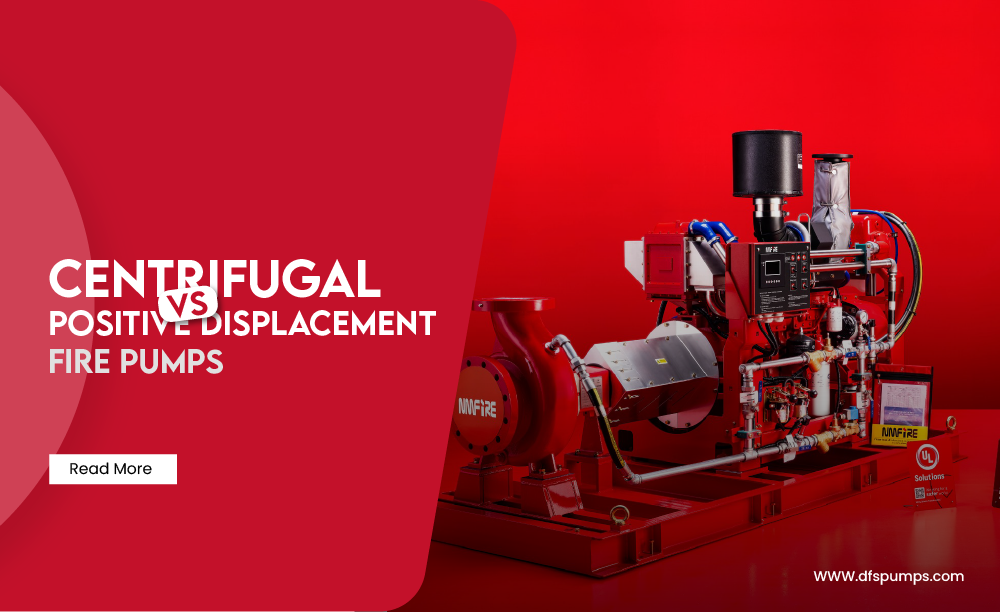
If you have ever looked at a fire pump specification and wondered why the choice always seems to come back to centrifugal horizontal split case, end suction, vertical turbine you are not alone. It is one of the most common questions that comes up during early project design, and the answer tells you a lot about how fire protection systems actually work under real emergency conditions.
There are two fundamental principles by which a pump moves water: centrifugal force and positive displacement. Both have a place in fire protection but their roles are very different, and understanding exactly why centrifugal pumps dominate the main fire pump market while positive displacement plays a narrower supporting role is genuinely useful knowledge for anyone specifying, buying, or maintaining fire pump systems.
This article breaks down both technologies from first principles, explains what NFPA 20 says about each, and gives you a clear picture of why centrifugal fire pumps command the overwhelming majority of fire pump installations across commercial, industrial, and high-rise applications including across Saudi Arabia’s rapidly expanding infrastructure.
How a Centrifugal Pump Actually Works
A centrifugal pump moves water by converting rotational mechanical energy into fluid velocity and then into pressure. Water enters the pump at the center of a spinning impeller. As the impeller rotates, centrifugal force throws the water outward toward the casing walls, where a volute or diffuser converts that velocity into pressure before discharging it into the piping system.
The key characteristic of this design is that the relationship between flow and pressure is dynamic it follows a pump curve. As flow demand increases, discharge pressure decreases. As flow demand drops to zero (what NFPA 20 calls the churn or shut-off condition), pressure rises to its maximum. This variable pressure-flow relationship is not a weakness. For a fire protection system, it is exactly the right behavior.
NFPA 20 formalizes this performance curve by setting three defined operating points that every UL listed and FM approved centrifugal fire pump must meet:
- At shut-off (zero flow / churn): The maximum pressure must not exceed 140% of the rated pressure
- At 100% rated flow: The pump must deliver its full rated pressure
- At 150% of rated flow (overload): The pump must still deliver at least 65% of its rated pressure
These three points define a standardized performance window that engineers can rely on when sizing systems. NFPA 20 lists rated capacities for centrifugal fire pumps from as low as 25 GPM all the way up to 5,000 GPM, covering everything from a small commercial sprinkler system to the fire water demands of a major industrial plant.
How a Positive Displacement Pump Works and Why It Is Different
A positive displacement pump works on an entirely different principle. Instead of using centrifugal force, it mechanically captures a fixed volume of liquid in a chamber whether through pistons, gear teeth, diaphragms, or rotors and forces that volume out with each stroke or revolution, regardless of the downstream pressure.
The defining characteristic of a positive displacement pump is constant flow regardless of pressure. If you increase back-pressure on a positive displacement pump, the flow rate stays almost the same. This is very useful in applications where precise, metered delivery of a fluid is critical which is exactly why these pumps appear in fire protection in a specific supporting role: foam concentrate proportioning systems.
In fixed foam suppression systems protecting tank farms, loading racks, and aircraft hangars, a positive displacement pump meters foam concentrate at a precise ratio into the water stream typically 1% to 6% by volume depending on the foam type and hazard. The positive displacement principle ensures the foam injection rate stays accurate regardless of flow variations in the water supply side. This is not a job for a centrifugal pump.
NFPA 20 also recognizes positive displacement pumps in another niche context: high-pressure water mist systems, where extremely fine droplets at pressures far above standard sprinkler system ranges are required for specific suppression applications. These are technically demanding, low-flow, high-pressure situations the complete opposite of what a main fire pump needs to do.
The Head-to-Head Comparison: Why Centrifugal Wins the Main Fire Pump Role
Factor | Centrifugal Fire Pump | Positive Displacement Pump |
Flow range | 25 to 5,000+ GPM | Low flow; limited range |
Pressure behavior | Variable — follows pump curve | Near-constant at any pressure |
Fire water system fit | Ideal — handles surge demand | Poor — overshoots at low demand |
NFPA 20 rated capacities | Fully standardized 25–5,000 GPM | Not rated for main fire pump duty |
UL/FM listing available | Yes — full certification path | Not applicable for main pumps |
Maintenance complexity | Low — few moving parts | Higher — seals, valves, gears |
Cost for high-flow apps | Very cost-effective | Expensive and impractical |
Correct application | Main fire pump in all building types | Foam proportioning, water mist |
Five Engineering Reasons Centrifugal Pumps Dominate Fire Protection
1. Fire Systems Need Variable Flow And Centrifugal Pumps Deliver It
A fire protection system doesn’t operate at a fixed, predictable flow rate the way a manufacturing process might. A sprinkler system activating in one zone of a building draws one flow rate. A full zone plus standpipe activation draws another. An open test header draws something else entirely. The centrifugal pump’s natural ability to follow demand across a wide flow range delivering more pressure when demand drops and maintaining adequate pressure when demand surges to 150% of rated flow makes it uniquely suited to this variable-demand operating environment.
A positive displacement pump in this role would create serious problems. At low or zero flow, it would build pressure until a component failed there is no natural pressure limiting mechanism in positive displacement design. Special pressure relief arrangements would be needed, adding cost and potential failure points. This is not a theoretical concern; it is the core engineering reason NFPA 20 does not list positive displacement pumps for main fire pump duty.
2. NFPA 20 Is Built Around Centrifugal Pump Performance
The entire hydraulic engineering framework of NFPA 20 the three-point performance requirement, the churn pressure limits, the overload capacity rules is built around centrifugal pump behavior. The standard defines rated capacities in standardized GPM steps. The acceptance test process measures pump performance against the factory-certified pump curve at churn, rated flow, and 150% overload. Every piece of this framework assumes a centrifugal pump.
This means that for any project requiring a UL listed and FM approved main fire pump which is essentially every commercial and industrial project subject to NFPA 20 a centrifugal pump is not just preferred: it is the practical standard the entire specification process is built around.
3. Few Moving Parts Mean Higher Reliability Over Time
A centrifugal pump is a mechanically simple device. The core rotating assembly is the impeller and shaft that is essentially it. There are no pistons, no valves, no gears, no diaphragms. This simplicity directly translates into reliability over the decades-long service life that fire pump systems are expected to provide.
Positive displacement pumps, by contrast, have more mechanical components in contact with the fluid gear teeth, piston seals, check valves, diaphragm membranes all of which are subject to wear, especially when handling water with any solids or chemical content. For a device that may sit idle for weeks between test runs and then needs to perform perfectly in an emergency, mechanical simplicity is a real advantage.
4. Centrifugal Pumps Handle the Full Spectrum of Fire Water Demand
Consider the range of applications a single pump range needs to cover: a small commercial building might need a 250 GPM end suction pump; a high-rise tower might specify a 750 GPM vertical turbine pump drawing from a subgrade tank; a large industrial facility might need a 2,500 GPM horizontal split case pump feeding a combined sprinkler, standpipe, and deluge network. All of these are centrifugal pumps. All are listed to UL 448 and FM standards. All operate within the NFPA 20 framework.
No positive displacement technology exists that can serve this range of fire protection applications in a cost-effective, standards-compliant format. The centrifugal pump’s scalability from small commercial to large industrial is one of the main reasons it achieved and maintains its market dominance.
5. Cost-Effectiveness at Scale Is Unmatched
Centrifugal fire pumps are manufactured at scale worldwide. The major pump types horizontal split case, end suction, vertical turbine, vertical inline are mature, standardized products with deep supply chains, well-understood installation requirements, and well-trained service technicians. This supply chain maturity keeps costs manageable even for large, high-flow specifications.
Positive displacement pumps for large-scale water applications are expensive to manufacture, require more complex installation, and have higher maintenance costs. For the niche roles they fill foam proportioning, water mist this cost is acceptable. For a general-purpose main fire pump application, it is not.
Where Positive Displacement Pumps Still Have a Role
To be clear: positive displacement pumps are not irrelevant in fire protection. They are simply not the right tool for the main fire pump role. Where they do belong:
- Foam concentrate pumps — metering AFFF, FFFP, or protein foam at precise injection ratios in fixed foam suppression systems protecting tank farms, loading racks, aircraft hangars, and refineries
- High-pressure water mist systems — where very fine droplets at pressures of 500 PSI or higher are needed for specialized suppression in turbine enclosures, data halls, or heritage buildings
- Priming pumps — some vertical turbine installations use a small positive displacement priming pump to establish prime before startup
- Jockey pump variants — some water mist system designs use positive displacement units as the pressure maintenance device
NFPA 20 itself acknowledges positive displacement in the context of water mist and foam proportioning. Section 4.26.1 of the standard notes that water mist positive displacement units are an approved method of maintaining system pressure specifically for high-pressure, low-flow water mist applications, not as a substitute for main fire pump duty.
What This Means for Specifying Fire Pumps in Saudi Arabia
For contractors, consultants, and facility managers working on projects across Saudi Arabia, the centrifugal vs. positive displacement question almost always resolves quickly once the application is understood. The main fire pump serving sprinklers, standpipes, hydrants, or water spray systems will be a centrifugal pump horizontal split case for high-flow industrial and commercial projects, end suction for mid-range applications, or vertical turbine where the water source is below grade.
What matters more at the specification stage is getting the centrifugal pump choice right: correct rated flow and pressure for the system demand, UL listing and FM approval confirmed, NFPA 20 performance curve verified, and the right drive configuration electric main pump plus diesel backup for the redundancy that Saudi Civil Defense requirements and NFPA 20 expect.
NMFIRE, available exclusively in the Kingdom of Saudi Arabia through DFS Pumps, manufactures all major centrifugal fire pump types horizontal split case, end suction, and vertical turbine all carrying UL listing and FM approval. Uniquely, NMFIRE is also the only fire pump manufacturer in the world that produces its own UL/FM certified diesel engine drivers, meaning every component of the electric-plus-diesel configuration carries independently verified certification from the same manufacturer.
Specifying the right centrifugal fire pump for your project starts with understanding the system’s hydraulic demand. Contact DFS Pumps for technical assistance, compliant pump selection, and NFPA 20 documentation support for your project in Saudi Arabia.