

Refineries, Chemical Plants & Power Stations: Why Industrial Fire Pumps Need to Be Different
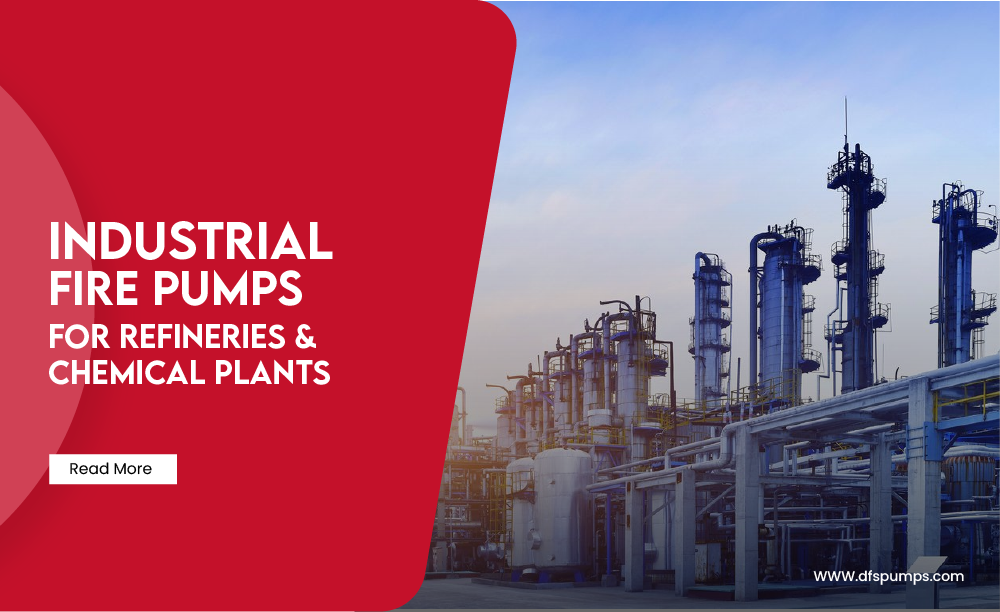
Walk through a typical office building and a fire pump is almost an afterthought a pump room tucked behind a stairwell, doing its job quietly in the background. Walk through a refinery, a petrochemical complex, or a power station, and the picture changes completely. Here, a fire pump isn’t protecting paperwork and furniture. It’s standing between a process unit handling thousands of barrels of flammable hydrocarbons and a fire that could spread across an entire plant in minutes.
That difference in stakes is exactly why industrial fire pumps cannot be treated as a scaled-up version of a commercial fire pump. The water demand is larger, the failure consequences are far more severe, and the operating environment is harsher in almost every respect heat, vibration, corrosive vapors, and round-the-clock duty cycles that a typical building system will never see.
In this article, we’ll break down exactly what separates industrial fire pumps used in refineries, chemical plants, and power stations from standard commercial fire pump systems and why getting this specification right matters more in Saudi Arabia’s industrial sector than almost anywhere else in the world.
Why Industrial Facilities Carry a Different Class of Fire Risk
A fire in a warehouse or office tower is dangerous. A fire in a refinery or petrochemical plant is a different category of event entirely. These facilities store and process large volumes of flammable and combustible liquids, often under pressure and at elevated temperatures. A leak at a flanged joint, a seal failure on a process pump, or an overheated bearing can ignite in seconds and escalate into a pool fire or jet fire that threatens adjacent equipment, structural steel, and personnel.
The financial exposure is equally severe. A single fire incident at a major processing facility can shut down production for weeks, trigger environmental liability, damage capital equipment worth tens of millions of dollars, and in the worst cases cost lives. Insurance underwriters know this, which is exactly why fire protection specifications for industrial sites are written with far less tolerance for compromise than residential or commercial codes.
This is the starting point for understanding why industrial fire pumps look, perform, and are tested differently from anything found in a typical building.
The Standards Governing Industrial Fire Pumps
It’s worth clearing up a common point of confusion first. The American Petroleum Institute’s API 610 standard governs centrifugal process pumps the pumps that move crude oil, refined products, and process fluids around a plant. It is not the standard for fire pumps. Fire pumps in refineries, chemical plants, and power stations are still governed by NFPA 20, the Standard for the Installation of Stationary Pumps for Fire Protection, the same standard that applies to commercial buildings.
What changes in an industrial setting is not which standard applies, but how demanding the application of that standard becomes. NFPA 20 requires every fire pump to be listed for fire protection service by a recognized testing laboratory such as UL or FM Approvals. In an industrial plant, this requirement sits alongside additional layers of protection that simply don’t exist in commercial buildings:
- NFPA 11 — governs foam fire suppression systems used for tank farms, loading racks, and flammable liquid storage areas
- NFPA 15 — governs fixed water spray systems used to cool vessels, pipe racks, and equipment exposed to radiant heat from a nearby fire
- NFPA 16 — governs foam-water sprinkler and spray systems, often used where Class A and Class B hazards exist together
- NFPA 25 — governs the ongoing inspection, testing, and maintenance of all of the above once installed
API also maintains close to 100 standards and recommended practices that are directly cited within NFPA codes, reflecting decades of collaboration between the petroleum industry and the fire protection community on exactly these risks. The result is that a fire pump feeding a refinery’s foam-water deluge system has to be engineered to deliver far higher sustained flow, for far longer duration, than the same UL/FM listed pump might need to deliver in a hotel or hospital.
What Actually Makes an Industrial Fire Pump Different
1. Far Higher Flow and Pressure Demands
A commercial sprinkler system might require a fire pump rated for a few hundred gallons per minute. A refinery protecting a tank farm or process unit with a deluge or water spray system can require flow rates many times higher, sustained for extended durations, because the hazard being protected a storage tank fire or a vessel exposed to flame impingement needs continuous cooling or suppression, not a quick burst of water.
This is why horizontal split case fire pumps dominate industrial applications. Their design supports high-flow handling with the structural strength to sustain that output reliably over long runtimes, which is exactly the demand profile a refinery or power station puts on its fire water system.
2. Hazardous Area Classification
Refineries and petrochemical plants are full of zones where flammable vapors may be present, whether continuously, intermittently, or only under abnormal conditions. Electrical equipment installed in these zones including fire pump controllers and electric motor drivers must meet hazardous area classification requirements so that the equipment itself cannot become an ignition source. This is a layer of engineering scrutiny that simply doesn’t apply to a fire pump room in a commercial office tower.
3. Backup Power Is Not Optional — It's Structural
NFPA 20 requires a reliable, redundant power arrangement for fire pumps everywhere, but in an industrial plant this requirement carries extra weight. If a fire breaks out during a grid disturbance a realistic scenario, since electrical faults are themselves a common fire cause in industrial facilities an electric-only fire pump is useless exactly when it’s needed most. This is why the combination of one electric-driven pump and one diesel-driven pump is the standard configuration specified across refineries, chemical plants, and power stations. The diesel unit doesn’t depend on the same electrical infrastructure that may have just failed.
4. Continuous-Duty Reliability Engineering
A fire pump in an industrial facility isn’t tested once a year and forgotten. NFPA 25 requires weekly inspections, monthly no-flow tests, and annual full-flow performance tests for every fire pump, and industrial sites given the consequences of failure typically run these test regimes with zero tolerance for deferred maintenance. The pump, the diesel engine, and the controller all need to be engineered for a service life measured in decades of repeated start-stop cycling, not occasional activation.
5. Environmental Resistance
Process plants are corrosive environments. Sulfur compounds, hydrocarbon vapor, salt-laden coastal air around Gulf refineries, and constant vibration from rotating equipment all accelerate wear on anything installed nearby including the fire pump house itself. Materials selection, coatings, and sealing arrangements for industrial fire pumps need to account for this, which is one reason factory-built, factory-tested pump packages have become the preferred approach over field-assembled systems in these environments.
Why Saudi Arabia's Industrial Sector Is a Critical Market for This
Saudi Arabia’s industrial base is one of the largest and most concentrated in the world. The Kingdom is home to massive integrated refining and petrochemical complexes, gas processing plants, and power generation facilities, with continued investment flowing into expansion projects tied to Vision 2030’s industrial diversification goals.
These facilities operate in one of the most thermally demanding climates on earth, where ambient temperatures routinely exceed 40°C. That heat load doesn’t just affect personnel comfort it directly affects diesel engine cooling performance, electric motor derating, and the thermal stress placed on fire pump components that may need to run at full output for extended periods during an actual emergency. Saudi Civil Defense mandates NFPA 20 compliance for project approval and licensing, and for industrial facilities specifically, getting this specification wrong is not just a compliance risk it’s an operational one, given how much capital and how many lives are concentrated on these sites.
Why UL/FM Certification Matters Even More in High-Hazard Facilities
NFPA 20 mandates that every fire pump be listed for fire protection service, but in a refinery, chemical plant, or power station, that listing is the only independent verification an operator has that the pump will actually deliver its rated flow and pressure under real fire conditions conditions these facilities are statistically far more likely to face than a typical commercial building.
NMFIRE, represented exclusively in Saudi Arabia by DFS Pumps, holds a distinction unique among fire pump manufacturers worldwide: it is the first company in China and the only company in the world to manufacture both UL/FM certified fire pumps and UL/FM certified diesel engines under one roof. For an industrial facility specifying a 1 Electric + 1 Diesel configuration the standard arrangement for refineries and power stations this matters directly. There is no compatibility gap between pump and driver, and no split accountability between two separate certification chains.
NMFIRE also holds APSAD certification from France, SETSCO certification from Singapore, and CCCF certification from China, and is the only Chinese member of the European Fire Sprinkler Network. For EPC contractors managing projects with international design reviews and multiple stakeholder approvals, this breadth of recognized certification reduces friction at every stage of project sign-off.
“According to NFPA 20 (2019 Edition), all fire pumps must be designed to ensure dependable operation at rated speed and flow under all specified conditions.” — referenced in NMFIRE technical documentation.
Pump Types Suited to Industrial Applications
NMFIRE’s product range includes the configurations most commonly specified for refineries, chemical plants, and power stations:
- Horizontal Split Case Fire Pumps — for high-flow process unit, tank farm, and deluge system protection
- End Suction Fire Pumps — for medium-demand zones within a larger industrial fire water network
- Vertical Turbine Fire Pumps — engineered with a maximum shaft speed limited to 1,800 RPM per NFPA 20, suited to facilities drawing from deep wells, reservoirs, or underground water sources
- Diesel Engine Fire Pump Drivers — UL/FM listed and built to deliver dependable backup power exactly when grid-dependent systems may be compromised
Getting the Specification Right From the Start
For EPC contractors, plant engineers, and project owners working on refineries, chemical plants, or power stations in Saudi Arabia, the fire pump specification decision should happen early ideally during the FEED or detailed design phase, not as a late-stage procurement item. The flow and pressure demands of foam, water spray, and deluge systems need to be calculated against actual process hazards, hazardous area classifications need to be mapped before equipment is selected, and backup power arrangements need to be confirmed against the facility’s actual electrical reliability profile.
DFS Pumps, based in Al Khobar in the heart of Saudi Arabia’s Eastern Province industrial corridor, works directly with project teams to specify, supply, and support NMFIRE fire pump systems matched to the real operating conditions of refineries, petrochemical plants, and power generation facilities across the Kingdom backed by genuine UL/FM certified equipment and local technical support throughout the project lifecycle.