

What Is a Fire Pump Controller and Why Does It Matter as Much as the Pump Itself?
Introduction
When a building’s fire suppression system fails during an emergency, the failure rarely starts at the pump. Nine times out of ten, the investigation traces back to the controller a component that many contractors specify as an afterthought, or worse, substitute with a cheaper, uncertified alternative to cut project costs.
This is one of the most avoidable and most costly mistakes in fire protection engineering.
If you are a consultant, contractor, or facility manager working on projects in Saudi Arabia, this post explains exactly what a fire pump controller does, why its certification matters as much as the pump’s, what NFPA 20 requires from it, and how the controller-pump pairing directly affects your Civil Defense approval and insurance coverage.
What Is a Fire Pump Controller?
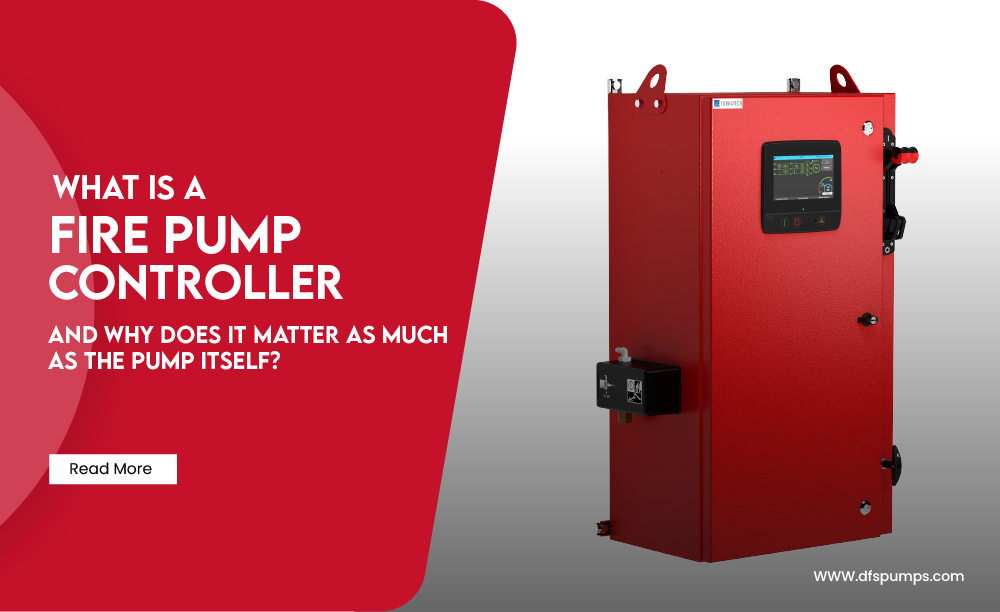
A fire pump controller is the dedicated electrical panel that monitors, starts, and supervises the operation of a fire pump. It is the brain of the fire pump system. Without it, the pump has no automatic start capability, no pressure monitoring, no alarm outputs, and no way to communicate a fault condition to building management or fire services.
The controller constantly monitors the system pressure through a pressure transducer connected to the pump discharge piping. When pressure drops below a preset threshold because a sprinkler head has activated, a deluge valve has opened, or a hose reel is in use the controller detects the drop and sends a start signal to the pump motor or diesel engine, automatically, within seconds, without any human intervention.
That automatic start response is exactly what NFPA 20, the Standard for the Installation of Stationary Pumps for Fire Protection, requires. The standard also requires that once a fire pump controller has started the pump automatically, it cannot stop automatically on its own. Manual intervention is required to stop the pump. This is a deliberate safety measure: the system must keep fighting the fire even if pressure is momentarily restored.
There are two primary categories of fire pump controllers:
Electric fire pump controllers are used with electric motor-driven pumps. They include a main circuit breaker or fuse, motor contactor, pressure sensing circuit, alarm outputs, weekly test timer, and in most configurations, an automatic transfer switch (ATS) that switches the pump to a backup power source if normal power fails.
Diesel engine fire pump controllers are used with diesel-driven fire pumps. Because a diesel engine requires cranking rather than direct electrical starting, the diesel controller manages battery-powered engine start sequences typically two sets of cranking attempts battery chargers, engine run monitoring, and a range of engine protection alarms including low oil pressure, high coolant temperature, and overspeed.
The Role of UL Listing and FM Approval
Not every panel that looks like a fire pump controller actually is one. Generic motor control panels can be built to roughly the same physical size and fitted with similar-looking components, but they are not designed, tested, or certified for fire pump service.
Fire pump controllers must be listed by Underwriters Laboratories to UL 218, the Standard for Fire Pump Controllers, or approved by FM Global to FM Class 1321/1323. These are the two primary certification bodies recognized by NFPA 20 and accepted by Saudi Civil Defense.
The UL listing process is rigorous. Manufacturers submit their designs to UL for evaluation against detailed performance and safety criteria. The controller must demonstrate correct pressure sensing and start response, proper alarm signaling, correct behavior under loss-of-power and power restoration scenarios, overcurrent protection behavior (NFPA 20 requires that the fire pump circuit breaker cannot trip on overcurrent during a fire it is set at 300% of motor full-load amperes to ensure the pump runs even under locked-rotor current), and reliable operation in the environmental conditions expected in a fire pump room.
Once listed, the manufacturer’s production facility is subject to ongoing follow-up inspections by UL to verify continued compliance. The UL mark on a controller is not a one-time certificate it is a continuously audited quality commitment.
FM approval carries equivalent weight and is particularly relevant for industrial and petrochemical facilities where FM Global is the recognized insurance testing and approval authority.
What NFPA 20 Requires From a Fire Pump Controller
NFPA 20 dedicates an entire chapter to fire pump controllers, and the requirements are specific. Here are the most important ones that consultants and contractors need to understand:
Automatic Starting
The controller must start the pump automatically upon sensing a pressure drop. The start pressure (cut-in point) and stop pressure (cut-out point) are field-adjustable, but automatic starting must be the default. Controllers must also accept remote start signals for example, from a deluge valve solenoid or a fire alarm system contact.
Cannot Automatically Stop
Once started by automatic pressure sensing, the pump must continue to run until manually stopped by an operator. This prevents the pump from cycling on and off, which could leave a fire suppression system without pressure at a critical moment.
Power Supply and Transfer
For electric fire pump controllers, NFPA 20 requires that the power supply be dependable and that where an alternate power source is available, an automatic transfer switch be provided. The transfer switch must switch to the backup source quickly typically within the time required for the motor to decelerate and must retransfer to normal power when it is restored.
Alarm Outputs
A compliant fire pump controller must provide dry alarm contacts for remote indication of critical conditions. These typically include: pump running, power failure or phase failure, circuit breaker in open position, low suction pressure, and for diesel controllers, battery failure, engine fail to start, engine overspeed, and high coolant temperature.
These alarm outputs connect to the building’s fire alarm system or a remote monitoring station. Without them, a failure in the pump room is silent no one knows the system is compromised until they test it or need it.
Pressure and Event Recorder
NFPA 20 requires controllers to record pressure data and system events. This record typically storing the last seven days of pressure history and the last fifteen days of events and alarms is essential for troubleshooting, maintenance documentation, and Civil Defense compliance verification.
Electric vs. Diesel Controllers: Key Differences
Because the starting mechanism is fundamentally different between electric and diesel fire pumps, the controllers are fundamentally different in design.
An electric fire pump controller manages power switching. Its most critical component beyond the pressure sensing circuit is the automatic transfer switch. The ATS monitors normal and alternate power source voltage and frequency, initiates transfer when normal power fails, and controls retransfer when normal power is restored. Phase reversal sensing is standard if a utility power fault results in reversed phase rotation (which would run the motor backwards), the controller detects this and prevents the pump from starting on that reversed phase.
A diesel engine fire pump controller manages battery-powered starting. It includes two independent battery chargers one for each of the two battery sets used for engine cranking. The cranking sequence is defined by NFPA 20: the controller makes multiple cranking attempts in alternating cycles. If all cranking attempts fail, the controller signals a fail-to-start alarm. The batteries must be maintained in a state of full charge at all times, and the controller monitors battery voltage continuously. For projects in hot climates like Saudi Arabia, battery health is a serious operational concern heat accelerates battery degradation, and a controller that does not actively monitor and alarm on low battery voltage is a liability.
The Bottom Line for Saudi Arabia Projects
Saudi Arabia’s fire protection regulatory environment has grown significantly more rigorous over the past few years. The 2025 updates to the Saudi Building Code and the Saudi Fire Code introduced enhanced standards around digital documentation, inspection intervals, and equipment approval requirements. Civil Defense inspectors check controller panels as part of every fire protection system inspection, and the documentation trail from manufacturer listing certificates to commissioning test records and weekly test logs must be complete.
Getting the pump right matters. Getting the controller right matters equally.
DFS is the exclusive agent for NMFIRE fire pumps in Saudi Arabia and supplies Tornatech fire pump controllers for projects across the Kingdom. If you are working on a project that requires a certified, correctly specified fire pump and controller package with full documentation support for Civil Defense approval contact our technical team.
fire pump controller, fire pump controller NFPA 20, UL listed fire pump controller, fire pump controller Saudi Arabia, fire pump controller KSA, Tornatech fire pump controller, NMFIRE fire pump, fire fighting system Saudi Arabia, fire pump control panel, diesel fire pump controller, electric fire pump controller, Civil Defense fire pump approval, fire pump controller FM approved, NFPA 20 fire pump requirements, DFS pumps KSA